
Management accounts
Monthly reporting that tells you what the business actually did and what it means. Written for the person running the company, not for another accountant.
What management accounts are
Management accounts are an internal set of financial reports produced monthly or quarterly. Unlike annual financial statements, they are not a statutory requirement and not prepared for SARS. They exist for one reason: so the people running the business can see what is happening while there is still time to do something about it.
A useful set contains a profit and loss compared against the prior month, the prior year and budget where one exists, a balance sheet, a cash flow view, a debtors age analysis, a creditors age analysis, and the two or three ratios that matter for your particular business. And a commentary, which is the part most providers skip.
Why your bank asks for them
South African banks and funders routinely require management accounts for overdraft facilities, asset finance, business loans and facility reviews, typically no older than three months. Annual financial statements are between six and eighteen months out of date by the time a credit committee sees them, which tells a lender nothing about your current position.
Businesses that cannot produce management accounts on request are either declined or delayed while they scramble to assemble something, and assembled in a hurry is exactly when it looks worst. Having them monthly turns a funding conversation into a document you already have.
What ours contain
- Profit and loss. Current month and year to date, compared to the prior year and to budget where you have one, with variances explained rather than just displayed.
- Balance sheet. With the movement on the key accounts explained: what happened to debtors, to stock, to the loan accounts.
- Cash. Where the cash actually went, which is frequently not where the profit went. This is the single most useful page for most owners.
- Debtors age analysis. Who owes you, for how long, and which accounts have stopped moving.
- Creditors age analysis. What you owe and when it falls due, so a cash position is a real one.
- Ratios that suit your business. Gross margin by line, labour as a percentage of revenue, average collection days, stock turn. Not a generic dashboard of forty metrics nobody reads.
- Commentary. A short written note on what changed, why, and what deserves attention this month.
The commentary is the point
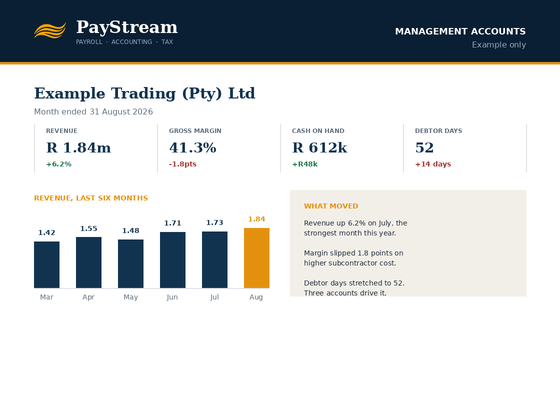
A set of reports with no interpretation puts the analytical work back on the business owner, who usually is not an accountant and did not ask to become one. Our commentary is a few paragraphs in plain language: gross margin moved and here is why, debtor days have stretched from 38 to 52 and these three accounts are the cause, payroll as a percentage of revenue has crossed a threshold worth noticing.
That is what turns reporting from a compliance artefact into something that changes a decision about pricing, hiring or collections.
Budgets and forecasts
Management accounts are considerably more useful with something to compare against. We build an annual budget with you at the start of the financial year, broken down by month so seasonality is reflected, and then report actual against it every month. Where cash is tight, a rolling thirteen week cash flow forecast is normally the more urgent tool, and we build and maintain that too.
Scope
What you get
Monthly or quarterly
On the cycle that suits the business, delivered within an agreed number of days after month end.
Full report pack
Profit and loss, balance sheet, cash, debtor and creditor ageing, and relevant ratios.
Comparatives
Against prior month, prior year and budget, with variances explained not just shown.
Written commentary
A few paragraphs in plain language on what changed and what deserves attention.
Bank and funder ready
In the format and recency lenders ask for, so a facility review is not a fire drill.
Budget and forecast
Annual budget built with you, plus a rolling thirteen week cash flow forecast where cash is tight.
Questions
Management accounts: common questions
What are management accounts?
An internal set of monthly or quarterly financial reports: profit and loss, balance sheet, cash position, debtor and creditor ageing and relevant ratios. They are not a statutory requirement and are not submitted to SARS. They exist so the business owner can see performance while there is still time to act on it.
Why does my bank want management accounts?
Because annual financial statements are out of date by the time a lender sees them. Banks and funders in South Africa typically require management accounts no older than three months for overdrafts, asset finance, loans and annual facility reviews.
How soon after month end do I get them?
We agree a delivery date with you and work to it, normally within ten to fifteen business days of month end depending on how quickly the underlying information reaches us. Reporting that arrives six weeks late has lost most of its value.
Do I need management accounts if my business is small?
If you are turning over a few hundred thousand rand a year and the owner sees every transaction, probably not monthly. Once there are staff, stock, credit customers or more than one revenue line, running on instinct starts to get expensive. The usual trigger is a surprise: a month that felt busy but produced no cash.
What is the difference between management accounts and annual financial statements?
Management accounts are internal, monthly, forward looking and not audited. Annual financial statements are a statutory year end product prepared to IFRS for SMEs for SARS, shareholders, lenders and any future buyer. You need both, for different reasons.
Can you compare against a budget?
Yes, and it makes the reporting far more useful. We build an annual budget with you, broken down by month so seasonality is reflected, then report actual against budget every month with the variances explained.
Let's put a number on it.
Tell us your headcount and what you need covered. You get a written, fixed monthly quote within 48 hours. No obligation, no sales pressure.